Thursday, February 26, 2015

BE HAPPY, IT’S PURIM

BE HAPPY, IT’S PURIM


For the uninitiated Purim might not seem like a big deal and it’s actually a 
pretty minor holiday in the Jewish calendar. But from a celebration perspective, 
it’s huge! My younger son categorizes it as another “they tried to kill us, we 
survived, let’s eat” holidays. However, delving deeper beyond the surfacethere 
is a lot to celebrate. If you know the basic story—King Ahashverosh becomes 
annoyed with his queen and decides to seek a new one. Mordechai encourages 
his niece Esther to participate in the pageant and she is selected as the new 
Queen, but doesn’t tell anyone she is Jewish. Haman, the king’s prime minister, 
plots to exterminate all the Jews of Persia. His plan is foiled when Queen Esther 
confides in the king that she is Jewish and tells him what Haman is up to and a 
counter plot is created.
CELEBRATING PURIM

As with all Jewish holidays, Purim begins at sundown, so this year, it begins on 

Wednesday, March 4. It is a festive evening of song, food, and the reading of 

the story of Esther which is found in the Hebrew Bible. This is one reading that 

is read from a scroll, much like the Torah, except it is called a megillah (story). 

(Other megillah readings are Ecclesiastes, Song of Solomon, Ruth and 

Lamentations.) This is also one loud, raucous reading. If you are looking for a 

decorous, sedate introduction to Jewish life, Purim is not the time for your first 

synagogue visit. People dress up as characters from the story and the play is 

acted out as characters from the Esther story appear in popular fictional 

stories. Some of the recent productions I have seen are Lion King, Grease, and 

Mary Poppins, pretty much any popular movie or TV show. This year our 

congregation is doing a take-off on Hell’s Kitchen—should be interesting!  


Purim is one of the more unusual holidays: Esther is the only biblical book in 

which God is not mentioned. Purim, as has already been mentioned, is, like 

Chanukah, traditionally viewed as a minor festival, but has been elevated to the 

status of a major holiday due to the Jewish historical experience. Finally,Haman 

became the embodiment of every anti-Semite everywhere Jews ever lived and 

experienced oppression. The significance of Purim has less to do with its 

historical roots as it does with the hope and affirmation it rekindles each year 

as we are reminded of Jewish survival despite persecution and Antisemitism 

over the course of so many centuries. The real miracle of Purim is the 

continuous survival of the Jewish people despite insurmountable odds and that 

is reason enough for celebration.

A LITTLE BIT OF HISTORY


So, let’s go back to some basics….you might be wondering what the word Purim 

actually means. The word is of Persian origin which makes sense considering

the story takes place in Persia which was actually an ancient kingdom within 

Iran. Pur means “lot” and purim is the plural form meaning “lots”. Haman, the 


evil prime minister, drew lots to decide what month would be most 

advantageous for an attack against the Jews. The festival of Purim falls in the
middle of the Jewish month of .You may be wondering why 

that is important and that’s a good question. It wasn't significant for Jews, but 

it was significant for Persians because ancient Persians believed that the signs 

of the Zodiac affected their destiny, and therefore, accorded great honor to 

magicians and astrologers. Many scholars believe that Haman chose the lot to 

fall in the middle of Adar because an important festival of the goddess Anahita 

was celebrated then and he wished to turn the people against the Jews during 

that time of celebration. And, it almost worked.

Except for two things: Esther was now queen and her cousin Mordechai wasn't 

about to let this happen. So, they did they own conniving and eventually, it 

was Haman who ended up hanging for his crimes and the Jews of Shushan City
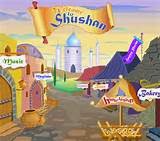

were saved. Purim is celebrated today with much 

merriment and rejoicing in synagogues and community centers all over the 

world. The story is read from the megillah, special foods are prepared (of 

course!), people dress in costumes, games are played; it is the ultimate 

triumphant carnival experience. 

WHAT YOU WILL NEED

By now you may be thinking, this is all well and good, but how do we actually 

do this? Ah, well, here’s a list of what you need for the ultimate Purim 

experience:

A rendition of the Purim story usually read from a scroll
                                                                                                    
Groggers—noise makers of some sort
                                                                 
Hamentaschen--three corner cookies that represent Haman’s pockets
                                                                                                                 
Costumes—generally relating to characters from story


Assortment of games—school carnival type

Wine—for the adults 


Lots of food—for everyone

Mishloach Manot—gift baskets for friends, neighbors, shut-ins, anyone you wish 

to share them with


Once you have everything arranged, the fun begins. If you are a first-timer, I 

suggest you attend a Purim celebration at a local synagogue or community 

center or with friends who have done this before. Generally on the evening 

before the story is read with much merriment and noise every time Haman’s 

name is mentioned. The idea is to make enough noise to blot out the sound of 

his name from memory. Of course, his name continues to be remembered since 

this is done every year, but you get the idea. 

HOW TO CELEBRATE

Purim is a perfect opportunity for interfaith families to experience together. The 

story of the Jewish people overcoming the evil of one person is a tale that is 

timeless and one that resonates with so many cultures. In addition to baking 

hamentaschen together you can explore opportunities to teach about social 

justice by engaging in the custom of sharing mishloach manot. You can easily 

extend the idea of mishloach manot beyond making gift baskets filled with 

hamentaschen to filling bags of toiletries for a homeless shelter, stocking the 

pantry in your local social service agency, collecting books for a domestic 

violence shelter—anything that brings your family together and turns the 

activity into a social action project.


    Baking hamentaschen is as easy as baking sugar cookies. There are 

numerous recipes online, just put “hamentaschen recipe” in your favorite 

search engine and see what pops up. Traditional hamentaschen are filled either 

with prunes or poppy seeds, but use your imagination. My favorites, besides 

poppy seed, are raspberry, chocolate chip and almond paste. Try a variety of 

fillings and decide what you like best. My grandmother made hers with soft 

yeast dough and filled the pocket with jelly; I have never found anyone else 

who made them like hers. If you find a source, please let me know; I get very 

nostalgic at Purim for Bubbies’ hamentaschen although I haven’t had them for 

many years.

    
    You may be wondering about the wine. There was a tradition that one should 

drink so much that you can’t tell the difference between ‘cursed be Haman’ and 

‘blessed be Mordechai’. At the same time, Judaism frowns on excessive drinking 

and encourages moderation. However, these are unusual circumstances, so the 

rabbis of the Talmudic era tended to relax their usual standards and authorize 

the excessive drinking in the spirit of merriment and unrestrained joyful 

celebration. Today we would add, if you are driving, don’t drink, and certainly 

don’t serve alcohol to minors, but please do celebrate with unrestrained joy!


If you would like to learn more about Purim, Judaism, other holidays and how 

you can enjoy them with your interfaith family please contact me at 

interfaithlifecoaching@gmail.com or go to my website, 


Thursday, February 12, 2015

LET'S TALK ABOUT CONVERSION, Part I

LET’S TALK ABOUT CONVERSION
Part 1

This is probably the most difficult topic for any interfaith couple, family, grandparent or individual—what about conversion? It is also a very private decision that should be made without any pressure from either side of the family. Just to be clear, I’m talking about converting to or from any religion, not just Judaism—keep that in mind as we move through this exercise. Since this is such a huge topic, this will be a three-part post: the first part about converting to Judaism; the second part will be about converting from Judaism to the faith of your partner and the third when conversion just doesn’t feel right to you. So, let’s try unpacking it by examining it from the perspective of someone converting to Judaism.

MAKING A DECISION TO CONVERT

It is entirely possible that your desire to convert to Judaism has nothing to do with an upcoming marriage or commitment ceremony. This may be something you have been considering for years but never acted upon because there was no compelling reason. Now, however, seems like an auspicious time; you have always envisioned yourself converting someday so why not now?

Years ago the idea of converting was met with skepticism: Why would anyone want to convert? People were routinely turned away (traditionally a rabbi had to turn a prospective convert away three times before engaging in study with that person) or obstacles were put in their way until they finally gave up. In much of the world the only path to conversion was, and still is, through the portal of Orthodox Judaism which didn’t suit many who were seeking. 

One of the most famous stories told about conversion is that of the sage Hillel who was approached by a man who wished to convert. He asked Hillel to teach him the Torah while standing on one foot. Hillel’s response was: “What is hateful to you, do not do to your neighbor: that is the whole Torah, the rest is the commentary, go and learn it.” (Babylonian Talmud: Tractate Shabbat, Folio 31a).

Where do you begin such a journey? In Judaism, there are two lifecycle events for which you really must have a rabbi at your side—conversion and a (Jewish) wedding. So, you do need to develop a relationship with a rabbi and it should be someone with whom you have a level of comfort and within a movement that meets your core values.

If this already sounds too complicated and you are overwhelmed before you get started, take a deep breath and keep going. First, this is one of the areas a life coach can assist you in getting started. That’s right! I am not a rabbi, but my experiences assisting other people in their journeys toward conversion have provided me with the skills and knowledge to help you with the preparations. A couple of sessions with me can help you clarify your core values and separate belief from tradition. Once you sort those out you will have a better idea of what kind of Jewish tradition you are seeking and how to move forward in the direction that is best suited to you. If this sounds interesting to you can reach me at www.interfaithlifecoaching.com and we can get started on your adventure.

Most mid-size to large communities offer an Introduction to Judaism course that typically runs for 14-16 weeks and meets on a weekly basis. The Union for Reform Judaism offers a 16-week course twice each year that is taught by area rabbis; the Jewish Outreach Institute offers courses throughout the country; Jewish Community Centers and Jewish Federations in many cities offer programs; frequently congregations will work in concert with one another to offer an opportunity to interested persons in the area; and, sometimes universities have courses through their continuing education departments.

Keep in mind there are a wide range of options on the continuum of Judaism—from Orthodoxy to Humanism—so it is important to spend some time deciding which movement meets your needs and most accurately lines up with your values, belief system and life style. There will be another post specifically detailing the choices that are available; I make no judgment on any of them, it is a personal decision. The only caveat I will offer you is that Messianic Judaism is not a valid choice if you are converting to Judaism.

For people who live in small towns or who are unable to attend weekly sessions due to scheduling conflicts more and more online opportunities have opened up in recent years. There are many individuals and couples who have completed both the conversion process and marriage counseling without actually meeting their rabbi in person before the conversion or wedding!

CONVERTING BEFORE MARRIAGE

There are many times a person chooses to convert prior getting married. Sometimes this decision is driven by a personal desire to do so; sometimes it is due to familial expectations. And often it is based upon a desire to be married by a particular clergy member or in a specific church or synagogue. Whether or not one decides to convert prior to marriage, there is a process that must be undertaken. In Judaism, one cannot simply walk into a rabbi’s office and state that you are would like to convert—today. It is at least a year-long process of study and meeting with a sponsoring rabbi, ergo the Introduction to Judaism class and the need for a rabbi to sponsor you to take the class.

If you are planning a wedding and wish to be married by a rabbi and complete your conversion prior to that date, you should start organizing your efforts as soon as you and your fiancĂ© realize this relationship is lasting and conversion is part of your future.  Please be aware that you will both be expected to attend the Introduction to Judaism classes; consider it a booster shot for whichever of you is already Jewish. Most rabbis today are happy to sponsor students seeking to clarify their desire to convert, but they do require you to meet with them, and they do expect you to be serious about your query.

It is not unusual for an individual to interview a couple of rabbis before deciding which one s/he would like to be the sponsoring rabbi; after all, you will be spending a lot of time with this person for the next year or more. It is also recommended that you visit the congregation and attend a few Shabbat services before making your decision. Most rabbis have requirements that conversion students attend either Friday night or Saturday morning services, or both, on a regular basis during the study period. You want to be certain you are in a community that meets your core values. A good place to begin would be in the movement your fiancé is already affiliated with, assuming that is some place s/he wants to remain.

CONVERTING AFTER MARRIAGE

It has been my experience that people either convert prior to marriage or wait until sometime long after they have been married. The exception is women who decide to convert while pregnant so there is no question that their child will be born Jewish and thus avoid the patrilineal vs. matrilineal debate at a later time. For those who wait, some may do so because they want to be able to participate more fully in the lifecycle events of their children, others may be moved by exposure over the years to the practices and traditions in Judaism and decide it is simply time to officially become part of the community.

Regardless of the reasons, the process is very similar—a period of study with your rabbi, participation in religious services, a public declaration of your intention to unite with the Jewish people. Generally when someone has been a long-time member of the congregation, the process may become truncated a bit because the rabbi already knows you and you have familiarity with the congregation and Judaism in general. However, it is still a huge commitment and none of the rabbis I have ever worked with bypassed the opportunity to engage on a personal level with anyone who was moving toward conversion no matter how long they had been part of the congregation.

WHAT ABOUT THE MIKVAH AND CIRCUMCISION?

I am always surprised when people ask about the mikvah and think 1) they must go to the mikvah, or 2) they cannot convert because they won’t be allowed into the mikvah. This could be a whole post in itself and I am not qualified to give a definitive, Halachic (Jewish law) answer to this question.

Here is what I can tell you: If you are converting under the auspices of an Orthodox or Conservative rabbi you will be required to go to the mikvah. If you are converting under the sponsorship of a Reform or Reconstructionist rabbi you may go to the mikvah depending on the rabbi, the availability of a mikvah in your community and your own preference. (Most Reform rabbis now encourage and/or require their students to use the mikvah which is a huge change from twenty years ago.) If you are leaning toward a Humanistic conversion you will most likely not go to the mikvah unless you feel strongly about doing so. Again, this is an overly simplistic answer so please do your research and discuss this with your rabbi. I have had the privilege of being present during a number of conversion ceremonies when people went to the mikvah; there was something transformative about the experience for each of them.

As for circumcision, if a man is already circumcised the process is relatively simple. It is hatafat dam brit or extracting a drop of blood to symbolize the reenactment of circumcision. Orthodox and Conservative rabbis require this; Reform and Reconstructionist generally recommend but there are varied opinions. For those who have never been circumcised, you should discuss your options with your rabbi because, again, this may depend on the movement under which your convert. In general both Orthodox and Conservative movements require circumcision while Reform and Reconstructionist will encourage it but not always insist. In the Reform movement, I have known men who have chosen to address this in a variety of ways from being circumcised, to hatafat dam brit, to immersion in the mikvah.

There are a number of great resources on the internet to begin your research. Among the ones I suggest are:
  • MyJewishLearning.com; 
  • InterfaithFamily.com; 
  • Union for Reform Judaism; 
  • United Synagogues for Conservative Judaism; 
  • Jewish Reconstructionist Community; 
  • Both Sides of the Family; 
  • Choosing a Jewish Life: A Handbook for People Converting to Judaism and for Their Family and Friends, Anita Diamont; 
  • The Complete How To Handbook for Jewish Living, Kerry Olitzky and Ronald Isaacs (both books are available at Amazon.com). 

SHARING YOUR DECISION

Whatever you decide, you will inevitably delight one side of the family and sadden the other unless one of your families is extraordinary. If your parents are active in their church and have a clergy person they are close to, it might be wise for you to make an appointment to speak to that person and seek guidance before broaching the subject. Be prepared for their priest or minister to question your motives and ask you to clarify the reasons for your decision. Instead of being defensive about it, understand he or she is only doing what your future spouse’s rabbi would do if the tables were turned (which they will be in the next post).

One of the reasons I suggest having this conversation is that it is very likely that your parents will ask you to talk to their priest or minister and you will be able to truthfully state you have already done so. It will also be helpful to the clergy person to have spoken to you if and when one of your parents contacts him or her for an appointment.

You can soften the blow by being prepared, by demonstrating that you are interested in your new faith and are becoming an active participant. If you were ambivalent about religion in the past, be enthusiastic when you are explaining the new rituals and traditions about which you are learning. Include them in your celebrations and clarify anything that is confusing for them. Allow them time to absorb your decision and to understand that you are not abandoning them or the values with which you were raised. You have simply found a divergent path that meets your needs and the needs of the family you are establishing. However, a word of caution is in order: Don’t be overly zealous—find a balance that is respectful and appropriate for your family.

FOOD FOR THOUGHT

This is going into a new blog post, but, the Jewish spouse must make sure s/he creates an inclusive atmosphere for the non-Jewish spouse/partner. Oftentimes problems surface when the Jewish spouse makes assumptions that the non-Jewish spouse understands specific traditions and cultural expectations without any explanations.
Perhaps what is needed more than anything is diversity training for interfaith couples and their extended families!

FINAL WORD

Just to reiterate, making the decision to convert is a personal decision. Choosing not to convert is also a personal decision and a valid option. This will be addressed in another blog post—there is too much material to address conversion both ways and retaining your own faith practices in one post. So, keep checking back for more information and be sure to contact Interfaith Life Coaching (www.interfaithlifecoaching.com) if there is a topic you would like addressed in this forum.

Next Time: 
Converting From Judaism to a Different Religion


Visit me at www.interfaithlifecoaching.com where I address all of your concerns regarding living in an interfaith relationship and building bridges, making memories and creating solutions while embracing faith, family and tradition.

Thursday, January 29, 2015

Celebrating Trees and Spring!

TWO-BIT WHAT?

TU B’SHEVAT—Celebrating Spring!

What do planting trees, eating fruit, celebrating the earth and the New Year all have in common? Tu B’Shevat, that’s what. In case you are wondering, Tu B’Shevat means “the fifteen of Shevat” or the 15th (tu) day of the Hebrew month Shevat which falls sometime in late January or early February according to our secular calendar. In 2015, it occurs on Wednesday, February 4. Actually, it’s the perfect holiday for everyone to celebrate together because there are no religious overtones to wriggle around and make sure everyone is comfortable and nobody feels left out.

And, it is one of the four Jewish New Years—time for a quiz: How many of you can name all four Jewish New Years? How many of you knew there were four Jewish New Years? Read through the rest of this post for the answer!

WHAT IS THE ORIGIN OF TU B’SHEVAT?

As with everything Jewish there is more than one answer to this question; there is also more than one spelling—sort of like Chanukah. The generally accepted opinion is that Tu B’Shevat was originally an agricultural festival that marked the beginning of spring. In the 17th century, Kabbalists created a ritual for Tu B’Shevat that is similar to a Passover Seder (seder means order so a seder is essentially a service or program that follows a certain order). Today, many Jews hold modern versions of a Tu B’Shevat seder.

The holiday is also known as the Jewish Arbor Day and has become a tree-planting festival in Israel, in which Israelis and Jews around the world plant trees in honor or in memory of loved ones and friends.  So, although for most of us in North America who are still digging out of snowstorms, in Israel, Tu B’Shevat signals the beginning of spring. The winter rains are ending and the pink and white almond blossoms are in full bloom, which is why the Rabbis in Mishnah (Code of Jewish Law, 200 CE) instituted Tu B’Shevat and the ensuing festival. Like Chanukah, Tu B’Shevat is a post-Biblical creation of the creation of the Rabbis, part of the system of tithes used to sustain the priestly class and the poor.


The portion relating to the New Year is based upon when a new annual cycle begins according to the Jewish calendar. Most of us assume this is Rosh Hashanah which occurs in the fall, however, in this instance, Tu B’Shevat signals the end of a crop year and therefore the tithes were due as the sap begins to rise and the trees begin to blossom. 


HOW DO WE CELEBRATE TU B’SHEVAT?

I’m so glad you asked! Tu B’Shevat is one of my favorite holidays for many reasons; the biggest is probably because it reminds me that spring really will come again. Even if you live in a climate where you still have snow on the ground, when you start talking about planting trees and harvesting fruit, how can you not become excited about the imminent return of spring? I have already mentioned that Tu B’Shevat, like Passover, is often celebrated with a Seder, and has a haggadah, or service book, but this one is very different than what you may have experienced at Passover.

A Tu B’Shevat Seder is divided into four sections that represent the four seasons. It is also divided into four mystical “spheres” representing the relationships between humans and the earth—Assiya (Actualization), Yetzira (Formation), Beriah (Creation), and Atzilut (Nobility). The Seder is celebrated with a variety of fruits and nuts—generally varieties that are found in the land of Israel—and four glasses of wine (or juice if you have children present!) in varying shades of red, from full red to white. There are many examples that are available on line but I will give you a brief outline of the basic elements here. Then you can go to your favorite search engine and simply insert “Tu B’Shevat Seder” and select your favorite. There are also several available for download on the URJ website, http://www.reformjudaism.org/have-tu-bishvat-seder. 


As the popularity of holding a Tu B’Shevat seder has grown, so have the number of haggadot, or books that lay out the service. Many contemporary Tu B’Shevat haggadot (plural for haggadah) bring in traditional texts to provide historical context for the rituals. Most of them in which I have participated or led group the fruits into three types:
  • fruits with touch outer shells and edible interiors (melons, peanuts, pomegranates, coconuts, citrus, almonds),
  • fruits with edible exteriors and inedible pits (dates, olives, plums, peaches, apples, etc.),
  • fruits that are entirely edible (berries, figs, grapes, etc.)

There is nothing sacred about this specific list; feel free to adjust according to dietary needs. If you are a nut sensitive family, or if someone in your group is allergic to or sensitive to nuts or any of these fruits, please do not include them. These fruits are chosen because they are said to represent different season and/or ways of being in the world, often following Kabbalistic categories. 

RESOURCES

If you have children in your home, or will be having them at your Tu B’Shevat Seder, PJ Library has several books that are appropriate for your use. You can access them at www.pjlibrary.org (if you have children 6 months-8 years and are not receiving PJ Library books, I strongly encourage you to look into whether or not your community offers them).  Other great resources for interfaith families are the URJ website, Interfaith Family, Jewish Reconstructionist Communities and MyJewishLearning.com. 

As always be cautious when using search engines to make certain you land on websites that are accepting and supportive of interfaith families and engage with all members of the family, not just the ones that are Jewish.

FURTHER CONNECTIONS

One of the many concepts I love about Judaism is the way we are able to connect threads from one holiday to the next and create a tapestry that depicts the whole of the Jewish year. A tradition for many is to plant parsley seeds during the Tu B’Shevat seder in preparation for Passover your seder. I confess that I do this every year and frequently have to purchase parsley since I don’t end up with enough—sometimes it doesn't even germinate—but I keep trying. I enjoy watching it grow in the window through the remainder of the winter as I long for the return of spring!  So, give it a shot and if you really want to have some fun, choose several varieties and make your own pot in which to grow your parsley! 


For those who believed you are genetically incapable of growing anything green, inhabitat.com has a Parsley Grow Pot for $19 in a bamboo pot that appears to be fool proof (I do not get anything for this, I just found it online and it looks like a great idea to me!)

AND FINALLY, THE FOUR NEW YEARS


As promised above, yes, there really are four New Years in a Jewish Year. Remember Judaism is based on a modified lunar calendar (a topic for another blog post) and there are four distinct New Years as follows:
  • The first of Nisan—also known in the Torah as the “first” month and the month during which Passover occurs. Like Tu B’Shevat, Passover occurs on the fifteenth of Nisan, usually in mid-March to early April although it may be as late as mid-April.
  • Elul is the sixth month of the Jewish year and the New Year for the tithing and counting of animals.
  • Tishrei is the seventh month of the year and the month by which the years are counted. Rosh Hashanah (literally the “head of the year”) is the first day of Tishrei; Jewish years are calculated from the creation of Adam. The current year is 5775. Rosh Hashanah also begins the period of The Days of Awe ending with Yom Kippur, the Day of Atonement.
  • The fourth New Year is Tu B’Shevat, the fifteenth of Shevat on which we honor the earth and celebrate the trees.

So there you have it—four Jewish New Years—you can astound your family and friends with the breadth of your Jewish knowledge.

Be Happy—It’s Tu B’Shevat!

Tuesday, January 13, 2015

WHAT HAPPENS WHEN YOU MOVE?

WHAT HAPPENS WHEN YOU MOVE?


Moving is stressful business, in fact on the scale of stressful events, it ranks among the top five. If you are moving in connection with a job change, you have hit two of the big five! The work itself gets underway long before you actually move. If you are a two-partner family it may begin with one of you coming home with an idea that there is a job someplace else that looks interesting. Or, perhaps an employer decides to transfer one of you to a new community. Sometimes, relocation is due to a job loss and finding a new job in another location. Whatever the specific circumstances, there is generally a great deal of discussion, angst, emotion, concern, and ultimately either resignation or enthusiasm.

Once the decision is made the process slips into high gear as your house has to be de-cluttered before it can be listed for sale, or you have to negotiate a release from your apartment lease, and housing in your new community must be secured. These are just the first of many decisions you will make over the coming months—the list can be overwhelming; schools for those who have children, a new job for the spouse who follows, medical professionals, recreational and sports activities; it’s a daunting journey.

FINDING A NEW CONGREGATIONAL HOME

In the frenzy of the activity, there is one aspect of the move that sometimes gets left off the list or at least ends up further down the list—finding a new congregational home. For those who are part of larger mainstream religious traditions, this may not be a big concern as it is usually easier to find a place that is welcoming and comfortable. However, for those who are Jewish, unless you live in a large metropolitan area, there is often little choice. And, if you are an interfaith family, you may find that what you left behind worked better for you than what your new home has to offer.

Conversely, the opposite may be true as well. You may have found your former home to be lacking in a place that met the needs of your family; your new community may be perfect for you. Whichever way you find yourself and your family, it’s still different. Worship styles vary, music is often not the same; even the time of services may be different.

If you are used to a large congregation and have moved to a smaller one, you may enjoy the opportunity to get to know people on a more intimate level. It may be refreshing to discover that when you walk into a room people actually remember who you are and call you by name. The flip side of that is there may be fewer children in the religious school and a smaller number of families with children to meet. Perhaps you have moved the other direction—from a small congregation to a larger one and you suddenly discover a new array of programs and activities for everyone in your family. You think this is great, but you miss being known as an individual and feel lost in a sea of parents, young adults, or empty-nesters. So, what do you do? 

DO YOUR RESEARCH BEFORE YOU MOVE

Here are some ideas for interfaith families when looking for a congregation in a new community:

  • Ask your current rabbi or educator for recommendations before your move.

  • If you are not part of a congregation, check with your local Jewish Federation or community center to find out what they know about the community.

  • Are there other interfaith families?

  • Visit websites and look to see what kind of programming is offered for interfaith families.

  • When you identify a congregation, ask the rabbi about their policies regarding the non-Jewish spouse participating in life cycle events.

  • What is the policy for children attending religious school? Do they only accept children with a Jewish mother (matrilineal descent), or do they also recognize children of Jewish fathers (patrilineal descent)?

  • Research to learn about the differences in denominational platforms regarding interfaith relationships—for example, which movements have rabbis that officiate at interfaith weddings? Which movements have rabbis that co-officiate at weddings?

  • If you are a same-sex couple or family, which congregations in your new community will be welcoming to you and your family?

There are no easy answers, and if you have a spouse who is also seeking a community of her/his own, you then have two new congregations in which to develop new friendships and create a place for yourselves. Many years ago my husband and I moved into an area that had no Jewish life at all. There was a military base nearby that offered services on a somewhat regular basis but I simply wasn’t comfortable with that as a solution. Fortunately we only lived there a year, but during that year I learned to seek people in unlikely places and search for kindred spirits wherever I was planted. 


Once you select a congregation that seems best suited to you and your needs, here are some suggestions to help you get started your new home:

  • Make an appointment with the clergy and introduce yourself; make sure s/he knows where you have moved from and find out whether or not you have mutual friends from the Jewish world.


  • If you have children in school make an appointment with the Educator and offer your services; you don’t have to teach Sunday School (but you can if you want, I’m sure s/he would be delighted), there is always a need for volunteers on Sunday mornings, during weekday Hebrew and throughout the week.


  • Volunteer in the office if you are not working—this is the heartbeat of every congregation and you will meet so many people this way.


  • Ask about social action projects and select one that is of interest to you; if you have a family choose something that will interest other members of your family as well.


  • Tap into social media and let people know where you have landed—undoubtedly you will be inundated with people who know people.


  • Attend events sponsored by the congregation, the local Federation, JCC and other affiliate organizations.


  • Be honest if you are struggling to pay dues and join a congregation; most of them would rather you join even if you can only pay a modest fee.


  • If there is a childcare center, you might want to consider enrolling your children so they can meet other kids and you can meet other parents.


If you aren't sure you are ready to make the commitment to a congregation you might want to consider joining the Jewish Community Center if your new city has one. They usually have a great selection of activities and you can test the water and try some activities. Most small to midsize cities have some kind Jewish cultural life occurring, you just have to be willing to spend some time searching. Being able to go online makes it much easier than in the past, and if there is a university or college that’s a great place to begin. And, again, make the most of social media and tap into any networks in which you participate. 

REACHING OUT 

As a newbie, you may think people ought to be reaching out to you, but the reality is that it doesn't always happen that way. One lesson I have learned over the years and moves is that initially we often ended up inviting people to our home far more frequently that we were invited to the homes of others. It takes time and energy to get established in a new community, even a faith community. However, the connections you make and the friendships you build are so worth the effort.
For parents of young children a place that might seem unlikely is the local library story hour. I met several people through the public library story hour in a community that had no organized Jewish community. My sons have typical Biblical names and one woman picked up on that and asked if I was Jewish. Responding hesitantly in the affirmative, I was pleased when she acknowledged that she was as well and proceeded to invite us to an upcoming event which served as our introduction to a small, but welcoming, Jewish community.

WELCOME HOME    


As a classic introvert, this is the hardest part of being the newcomer: reaching out to people you don’t know and taking that risk. I have learned it is much easier to move with children because you can use their school, sports, and religious activities as an entrĂ©e to creating a new community. Having just made a move without children, and as a spouse following a husband to a new job, this is uncharted territory. I hope you will join me as I write about my experiences over the remainder of this year. For the record: I have joined a congregation and am getting involved; but I must confess I did know the rabbi and his wife prior to moving here so that does make a difference. My husband has chosen not to participate in this venture at this time. I have selected a few activities that I find interesting and have met a number of people who have been very welcoming. The other aspects of relocation are in various stages of development and remain a work in progress; I will keep you posted in the months ahead.

If you are in the process of relocation, considering a move, or have just completed one, I hope you will find this information helpful. Whatever your current state of life, remember to be kind to yourself, remember to breathe, get regular exercise, tackle one issue at a time, and do not try to unpack all of the boxes in one day.

Life is a journey and moving as an interfaith family is one more passage along the way. Make some new memories and enjoy your trip!

L’shalom,

Margaret

Thursday, December 11, 2014

RAISING CHILDREN OF FAITH

I have received a number of responses from recent posts about the issue of raising children in one faith or the other. There are groups that espouse doing both and whatever your mindset you will be able to find experts that agree with you and present research to support your decision. Some of the objections of the “single religion” school are:  
  •          it’s not fair to the spouse of the other religion,
  •          it limits the children to exposure to only one faith tradition and thus marginalizes the other parent and        extended family, and
  •         since we are all seekers and will eventually find the path that is right for each of us, it makes more            sense to introduce children to a variety of traditions early in life.

However, I still believe children need to be taught about God, about faith, and about tradition in clear, direct conversations that leave no doubt about whom they are and what you believe.

I think perhaps we are asking the wrong questions: Instead of asking whether or not we should have a Christmas tree in a Jewish home, or whether or not we should be celebrating both sets of holidays, or if we should be raising our children exclusively in one religion, we should be asking ourselves if we and our children know who were are and what we believe.

On November 27, 2014, Huffington Post Religion offered an article by David Briggs entitled, “The No. 1 Reason Teens Keeps the Faith as Young Adults.” Briggs stated in part that one major determining factor was the level of engagement of parents while children were growing up. Perhaps this explains some of the success for those who are raised in interfaith homes where both religions are practiced—these parents were actively engaged in conversations regarding matters of faith.

My position is that children need, and deserve, to have a clear understanding of who they are and to be raised with a strong identity. That doesn't mean you ignore the other parent’s religion or culture. You embrace it, you celebrate, you learn about it and you teach your children to respect it, but you don’t teach them to worship it in the same way. In the same manner, you and your spouse ideally will be willing to learn about one another’s faith practices so you can have thoughtful conversations with your families, including any children you might have.

Another recent article that was pointed out to me by a friend was quite disturbing to me. It was written by a woman who had converted when her oldest child was still very young and before her two other children were born. But she felt her identity as a Jew, and that of her children, was always being questioned. She was never quite “Jewish enough” for the people in her congregation. This time of the year one of the reasons was obvious—they had a Christmas tree in their home.

This tree held no religious significance for her, it was simply a cultural symbol, and according to the article, she went to great lengths to make sure her children understood the difference. Her story is on Kveller.com; it was posted in December 2013 under the title “The Interfaith Message is Wrong” by Melissa Cohen. I agree that there is a problem, but I’m not sure it’s the message that is wrong. I wonder if it’s the shaming prevalent in many communities that is the source of the problem.

So many people believe themselves to be experts on how those who were not born into Judaism should express their adopted faith and practice and how to best blend their two traditions. They are so eager to share the wealth of their knowledge they don’t even wait until they are asked for advice. And when their valuable insights are not requested, they often resort to shaming in the form of criticism. Most of the time it’s not meant to be hurtful or antagonistic, it’s really meant to be helpful, but still, it hurts and it alienates.

One of my closest friends has been married to a man for over twenty years who was raised Catholic. They have four boys, all of whom have become Bar Mitzvah and so far the two oldest have been Confirmed. They are decidedly Jewish. They spend Christmas with their Dad’s family and go to church with them Christmas Eve.  And, oh yeah, they have a Christmas tree and presents every year in their home—a huge tree. Why? Because it’s part of his tradition and it was important to them that something of his culture be incorporated into their family. They also dye Easter eggs. There is nothing of religious significance in either of these actions; it is purely cultural, but still some chastise her for both. They live in a small town and some people don’t understand, it’s confusing for the community—how can they be Jewish and still have a tree and dye Easter eggs? Some members of their small Jewish community would prefer they be less visible. They think it would be easier for the community but would it be better for the family?

I share all of these examples of interfaith living because there is no right way; there is only the path that works for you. It isn't really about the tree. It’s about the way you live. It’s about the way you express your faith and practice your religion. It’s about your core values and ensuring that they are in sync with one another. It’s about passing on the values and traditions that are most important and enduring to both of you. It’s about making certain that your children understand the basic tenets of the faith traditions you observe and not confusing a tree or colored eggs for something other than what they are—cultural and family traditions.

Interfaith Life Coaching is about embracing family, faith and tradition. This is a great time of the year to begin a thoughtful reflection on your journey. Contact me at www.interfaithlifecoaching.com and let’s begin the conversation.
Happy Holidays,

Margaret

Thursday, November 20, 2014

BEING THANKFUL

Finally, a holiday that transcends the lines of ethnicity and religion (let’s put aside the trend of big box stores opening on this quintessential American holiday and threatening it’s very existence for a moment), and focuses on the core of who we are as humans—beings who are capable of giving thanks.

Without a doubt, Thanksgiving is my favorite holiday simply because I can fully participate without any feelings of something missing. I grew up in a large (I mean huge, not just large by Jewish standards), family with five siblings and dozens of cousins and aunts and uncles. Our Thanksgivings were noisy, chaotic, multi-generational, gastronomical wonders, and quite frankly, a little insane.

On that day I was just like everyone else in our neighborhood. I didn’t have to apologize for not having decorations on our house, I didn’t have to explain that I couldn't eat cake at Sally’s birthday party because it was Passover, I didn’t have to talk about Chanukah and that it really isn't the “Jewish Christmas”, I didn’t have to endure the “Jews killed Christ” comments at school. None of that mattered on Thanksgiving—we were all immigrants in one way or another and we were all thankful for something.

Over the years our traditions have changed, our big, noisy family has evolved. Many of us are now part of interfaith families and we are scattered across the country. Of necessity we have created new traditions. Still, for me, that sense of this being a day that goes to our core values and our ability to give thanks stays with me. It may sound corny and schmaltzy but it still works in my world.

What about you? What core values evoke a sense of thankfulness for you?  How do you want to move forward into this holiday season with the sweetness of being thankful in your heart? Have you considered giving thankfulness a more prominent place in your holiday planning instead of frenetic activity?

Here’s a challenge for you this week:
  • Think about the messages you are sending to your loved ones and the toll the holidays take on you each year.
  • Then think about whether or not there is a better way of spending the next six weeks.  
  • Take a chapter from Shabbat and try unplugging from some of the commotion.
  •  Make some active decisions about what you want to pursue rather than doing everything because they are things you have always done or can do.

May your blessings abound and may you be surrounded by loved ones on Thanksgiving. If you find yourself alone this Thanksgiving Day, find a place to volunteer your time and energy. There are many worthwhile organizations that always need an extra pair of hands—hospitals, nursing homes, homeless shelters, Ronald McDonald Houses are a few that come to mind.


And, as always, if you are interested in having a conversation about discovering, clarifying and prioritizing your core values please contact me at www.interfaithlifecoaching.com.

Happy Thanksgiving!

Margaret

Tuesday, November 4, 2014

LIFE IS A JOURNEY

Birth is a beginning
Death is a destination
And life is a journey

These are the words that begin a poem written nearly 40 years ago by Rabbi Alan Fine, Chicago, IL, that has been read prior to the Kaddish on Erev Yom Kippur since the mid-1970's. It is a poem with which I am so familiar, having borrowed it on many occasions that have nothing to do with Yom Kippur. The most recent of which was the memorial service of my dearest friend’s husband a month ago. He died two days before Erev Yom Kippur, and although neither of them were Jewish; I knew I had to share the poem with Jan. As I searched for it in the Machzor (High Holy Day prayer book), I finally located it immediately prior to the Kaddish prayer (I have copied it in its entirety at the end of this posting).

The next morning I went online, found the whole poem, printed it out and shared it with Jan. She read it and asked me to read it at the service that morning. So, on Yom Kippur morning, instead of sitting in shul praying, I was sitting in a condo community room that we had turned into a sacred space to celebrate the life of a man loved by all of those present. “Birth is a beginning, Death is a destination, And life is a journey…”

I write about our journeys as part of the interfaith experience because what else is this other than a journey through the lens of Judaism, our collective communities, and the faith communities of those whom we love? Our journeys began long ago—either as early as recorded history with the creation narratives, or with the story of Abraham and Sarah and their journey to the land of Ur, Abraham and Lot and their separate journeys, the Exodus from Egypt, or some other point in history to be the beginning of your journey. As you and your family move through your story and write the narrative that will become your history, consider how the decisions you make today about the place Judaism has in your life will affect the path you and your family travel.

Life is a journey

Birth is a beginning
Death is a destination
And life is a journey

and youth to age; 

From innocence to awareness 
and ignorance to knowing; 

From foolishness to desecration 
and then perhaps to wisdom. 

From weakness to strength or 
from strength to weakness 
and often back again; 

From health to sickness 
and we pray to health again. 

From offense to forgiveness 
from loneliness to love 

from joy to gratitude 
from pain to compassion 

from grief to understanding 
from fear to faith. 

From defeat to defeat to defeat 
until looking backwards or ahead 

We see that victory lies not 
at some high point along the way 

but in having made the journey 
step by step 
a sacred pilgrimage. 

Birth is a beginning 
and death a destination 

And life is a journey; 

A sacred journey to life everlasting. 


Wherever you go, may your journey be full of exciting adventures, memories, and peace.